Author name: safnameppalli@gmail.com

Uncategorized

How can I use content marketing for my business?

There is a quiet revolution happening in how businesses earn attention in Kerala. It is not loud, it does not involve massive budgets, and it does not require a celebrity endorsement or a prime-time television slot. It is happening one piece of content at a time — one Instagram caption, one YouTube video, one well-written blog post, one WhatsApp message that actually makes someone stop scrolling and think. This revolution has a name. It is called content marketing, and for new generation businesses across Areekode, Malappuram, and Kerala, it is quickly becoming the most powerful growth tool available. Let us be honest about what content marketing actually is, because it is one of those phrases that gets thrown around so often it starts to lose meaning. Content marketing is not just posting on Instagram. It is not writing a blog once a month and hoping for the best. It is the deliberate, strategic practice of creating and sharing information that is genuinely valuable to your ideal customer — so that over time, they come to trust your brand, think of you first when they need what you offer, and choose you over every competitor who is only shouting about how great their product is. The difference between a brand that uses content well and one that does not is the difference between earning a customer and chasing one. The starting point for any new generation business trying to use content marketing effectively is clarity about who you are trying to reach. Not everyone. Not a vague idea of “young people in Kerala.” A real, specific human being — someone with a particular problem, a particular aspiration, a particular way of spending their time online. When you know exactly who you are talking to, every piece of content you create becomes sharper, more relevant, and more likely to connect. A clothing brand in Malappuram speaking to young working women who care about modest fashion and local craftsmanship will create completely different content from one trying to speak to everyone simultaneously — and their content will perform dramatically better because of that specificity. Once you know your audience, the next question is what kind of content will actually serve them. This is where new generation businesses have a remarkable advantage over older brands that are still thinking in terms of traditional media. Content today can take a hundred different forms — short-form videos, long-form blogs, email newsletters, podcast episodes, behind-the-scenes stories, customer testimonials, product tutorials, opinion pieces, local news commentary, and so much more. The key is to match the format to both your audience’s habits and your own genuine strengths. If you are naturally good on camera, video is your weapon. If you write well and think deeply, long-form content will build you an audience that trusts you at a level that viral videos rarely achieve. As the best digital marketing strategist in Areekode, Malappuram, and Kerala, one of the most important conversations I have with business owners is helping them find the content format that they can sustain — because consistency always beats perfection. Consistency is the secret that most businesses miss when they try content marketing and give up. They publish ten pieces of content, see modest results, and conclude that content marketing does not work for them. What they have actually discovered is that content marketing does not work instantly — which is a completely different thing. Content marketing is a compounding strategy. Each blog post you publish adds to your website’s SEO authority. Each video you upload adds to your channel’s credibility. Each email you send deepens your relationship with your subscriber list. None of these individual pieces is transformative on its own, but together, built over months and years, they create a digital presence that is extraordinarily difficult for competitors to replicate or overtake. For businesses in Kerala, content marketing has a dimension that makes it especially powerful — the regional opportunity. The Malayalam-speaking internet audience is enormous, deeply engaged, and dramatically underserved by quality branded content. Most national brands are still producing English-first content that feels distant and corporate to local audiences. A business in Areekode that creates content in Malayalam — content that reflects local culture, local humor, local values, and local ways of speaking — immediately feels more trustworthy and relatable than any polished national campaign. Language is identity, and brands that speak their customer’s language, in the truest sense, earn a level of loyalty that is very hard to build any other way. SEO and content marketing are inseparable twins for new generation businesses serious about long-term growth. Every piece of content you publish on your website is an opportunity to rank for a search query that your ideal customer is typing into Google right now. Blog posts that answer real questions your customers have, product pages that explain your offering in genuine depth, landing pages built around the specific language your local audience uses — all of these become permanent digital assets that bring organic traffic to your business long after they were first published. Unlike paid advertising, which stops generating results the moment your budget runs out, content that ranks well in search keeps working for you indefinitely. Social media amplifies content marketing but should not be mistaken for the whole of it. Platforms come and go — what was mandatory three years ago may be irrelevant tomorrow. The businesses that build their content marketing on a foundation of owned channels — their website, their email list, their YouTube channel — are building assets they control. Social media is the distribution layer on top, not the base. New generation businesses that understand this distinction build marketing ecosystems that are resilient, scalable, and not dependent on the changing moods of any single algorithm. Content marketing, done with strategy and patience, does something that no single advertisement can ever achieve. It builds a brand that people genuinely believe in — a brand they recommend to friends, return to repeatedly, and feel

Uncategorized

How do I improve the SEO ranking of a website?

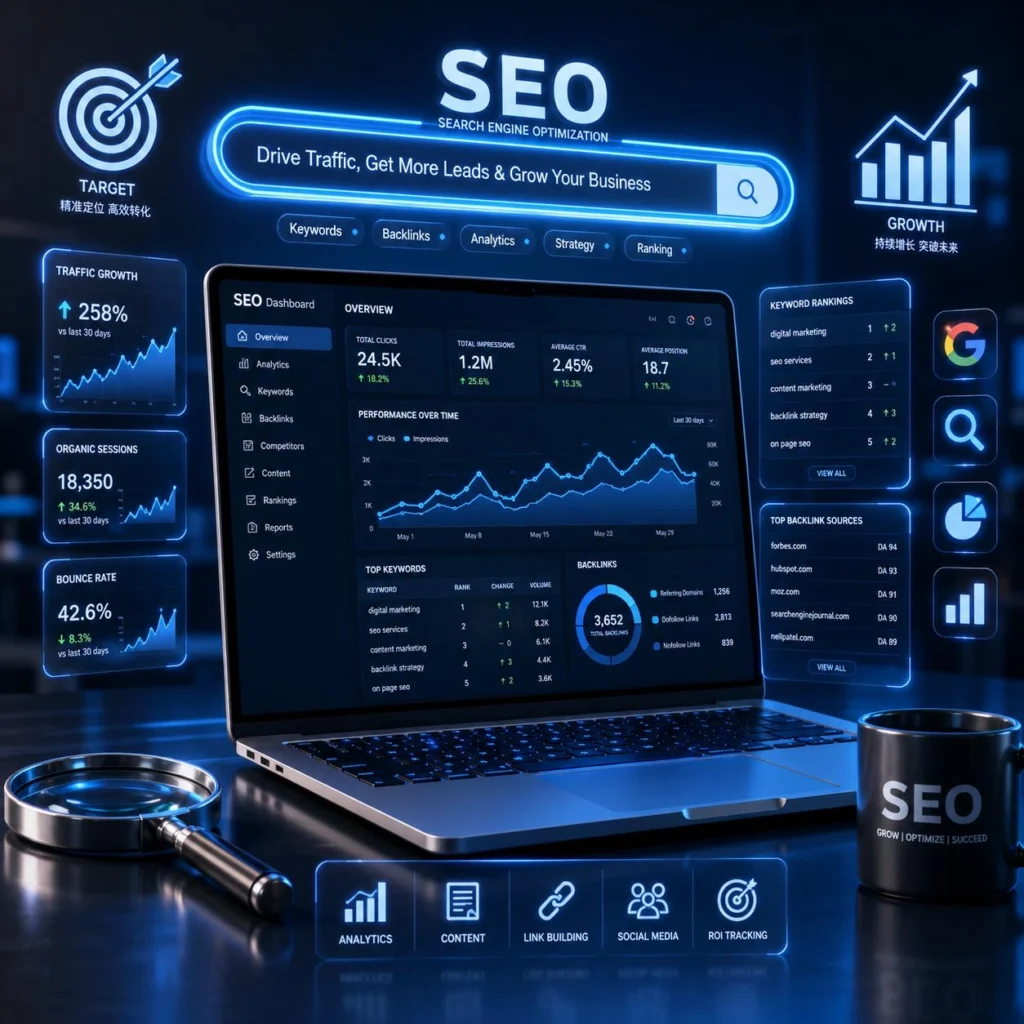
Every new generation business owner in Kerala has felt it at some point. You build a beautiful website, write a few pages, maybe even post some content — and then nothing happens. No traffic, no inquiries, no visibility. The website sits quietly on the internet like a shop in a lane no one walks through. The product is good, the brand is sharp, but somehow Google is not sending anyone your way. The problem, almost always, is SEO — and the solution is less mysterious than most people think. Search engine optimization is the practice of making your website understandable, trustworthy, and relevant in the eyes of Google. When someone in Malappuram types “best tailor near me” or “digital marketing agency in Kerala” into the search bar, Google runs through millions of pages in a fraction of a second and decides which ones deserve to be seen. The websites that appear at the top are not there by accident. They have been built and maintained in a way that signals to Google — consistently and clearly — that they deserve that position. As someone working as the best digital marketing strategist in Areekode, Malappuram, and Kerala, I have helped businesses climb those rankings from scratch, and what I have learned is that SEO success comes down to a handful of principles done right over time. The first thing any business needs to get right is the foundation — the technical health of the website. Google cannot rank a page it cannot read. If your website loads slowly, breaks on mobile, has pages that do not connect properly, or carries errors that confuse search crawlers, none of the content work you do on top of it will matter. Mobile optimization is especially non-negotiable in Kerala, where the vast majority of internet users are accessing websites entirely through their smartphones. A site that loads in under three seconds on a mobile connection is not a luxury — it is the baseline requirement for being competitive in search today. Once the technical foundation is solid, the next layer is content — and this is where most new generation businesses either win or lose their SEO battle. Google’s entire job is to match a user’s question with the most helpful, relevant, and trustworthy answer available. Your content needs to be that answer. This means writing not just to rank, but to genuinely inform, help, and serve the person reading. Thin content, keyword-stuffed paragraphs, and pages that say nothing useful are penalized heavily by modern algorithms. What works is depth, clarity, originality, and content that actually reflects your expertise and understanding of your industry. Keywords still matter deeply, but how you use them has changed entirely. The approach today is not to repeat a phrase as many times as possible — it is to write naturally about a topic in a way that covers everything a reader might want to know. When your content is thorough and honest, it naturally includes the language people are using to search for it. For businesses in Areekode and Malappuram trying to rank for local searches, this means creating content that speaks specifically to your local market, your local customers, and the specific problems your local audience is trying to solve. Generic national content will rarely outrank established players — but hyper-local content, done well, can dominate its niche completely. Local SEO deserves special attention here because it is one of the highest-leverage opportunities for businesses in smaller cities and towns across Kerala. Setting up and fully optimizing your Google Business Profile is the single fastest way to start appearing in local search results and on Google Maps. Your profile needs an accurate address, consistent contact details, real photos, updated working hours, and — critically — a steady stream of genuine customer reviews. Reviews are one of the strongest local ranking signals Google uses, and businesses that actively encourage satisfied customers to leave feedback are building an SEO asset that compounds in value over time. Backlinks — links from other websites pointing to yours — remain one of the most powerful ranking factors in SEO. Think of them as votes of credibility from the wider internet. A website that other reputable websites reference and link to is seen by Google as more trustworthy and authoritative. For new generation businesses, building backlinks does not have to mean cold outreach and complicated link exchange deals. It can start simply — getting listed in local business directories, contributing expert opinions to industry publications, collaborating with other local brands, or creating content that people naturally want to share and reference. Every legitimate link you earn is a long-term investment in your domain’s authority. On-page SEO is the connective tissue that holds everything together. Every page on your website should have a clear, keyword-relevant title tag, a compelling meta description that makes people want to click, properly structured headings that help both readers and search engines understand the content, and images with descriptive alt text. These are not complicated changes — but they are consistently overlooked by businesses that build websites without an SEO lens, and fixing them can produce noticeable improvements in ranking within weeks. Consistency is the quality that separates businesses that see real SEO results from those that give up after two months. SEO is not a one-time project. It is an ongoing commitment to publishing useful content, maintaining technical health, building authority, and earning trust — month after month, year after year. The businesses in Kerala that are dominating search results today started this process years ago and never stopped. The businesses that will dominate five years from now are the ones starting seriously today.

Uncategorized

WHAT IS AI’S IMPACT ON DIGITAL MARKETING?

If you have been watching the business landscape in Kerala over the past couple of years, you already know that something has shifted. The small café in Kozhikode that once relied solely on word-of-mouth is now running targeted Instagram ads. The boutique clothing brand in Malappuram is using automated email sequences to convert browsing customers into loyal buyers. And the entrepreneur who once needed an entire agency behind them is now running campaigns with just a laptop and the right tools. At the heart of all of this transformation is one force — artificial intelligence.AI is not some distant technology reserved for Silicon Valley giants anymore. It has quietly entered the daily workflow of businesses across Kerala, and those who understand how to use it well are already pulling ahead. As someone working as the best digital marketing strategist in Kozhikode, Malappuram, and Kerala, I have seen this shift happen in real time — and what excites me most is not the technology itself, but what it unlocks for new generation businesses that are hungry, ambitious, and ready to compete on a larger stage.Let us talk about what AI is actually doing to digital marketing today — not in theory, but in the real world where businesses are trying to grow, connect, and convert.The first and perhaps most profound change is in how content gets created and distributed. A few years ago, producing consistent content across multiple platforms was exhausting. You needed writers, designers, schedulers, and analysts all working in sync. AI has compressed much of that pipeline. Tools powered by machine learning can now help draft copy, suggest headlines, generate visual ideas, and even predict which type of content will perform well with a specific audience — before you even publish it. For new generation businesses, this means the playing field has leveled significantly. A startup in Kozhikode can now produce the kind of content volume and quality that once only large brands with big marketing budgets could afford.But content is just the surface. Where AI truly earns its place in digital marketing is in audience understanding. Traditional marketing relied on demographic assumptions — age, gender, location. AI goes much deeper. It reads behavioral patterns, tracks micro-moments, identifies intent signals, and helps marketers understand not just who their audience is, but what they are about to do next. For a business in Malappuram trying to reach the right customer at the right moment, this level of precision is a game-changer. You stop wasting budget on broad targeting and start spending smarter on people who are genuinely ready to buy.Personalization is another area where AI is making a dramatic difference. New generation consumers — especially the ones driving economic activity across urban and semi-urban Kerala — do not respond well to generic marketing. They have grown up with Netflix recommendations, Spotify playlists curated to their mood, and Amazon suggestions that feel almost eerily accurate. They expect the same from the brands they engage with. AI enables businesses to deliver that kind of personalized experience at scale — personalized emails, dynamic website content, product recommendations, and even customized ad creatives — all without manually segmenting every campaign by hand.Search engine optimization, the backbone of long-term digital visibility, has also been completely transformed by AI. Google itself now uses AI at the core of how it ranks content. This means that keyword stuffing and old tricks no longer work. What AI-powered SEO demands is context, relevance, and genuine value — and interestingly, that is also exactly what users want. For businesses in Kerala trying to rank for competitive terms and dominate their local market, understanding how AI reads and evaluates content has become essential knowledge. The best digital marketing strategist in Kerala today is not someone who chases algorithms — they are someone who understands how AI thinks and builds strategies that align with it.Paid advertising has become smarter too. Google Ads and Meta Ads now rely heavily on machine learning to optimize campaigns in real time — adjusting bids, rotating creatives, targeting lookalike audiences, and reallocating budget toward what is working.This is a chance as well as an obligation . The opportunity is that AI can help your ads perform better with less manual intervention. The responsibility is that you still need to feed the machine the right inputs — compelling creatives, well-defined objectives, and clean data. Businesses that understand this combination are seeing returns that were almost unimaginable five years ago.Customer service and engagement have also changed. AI-powered chatbots and automated response systems now handle the first layer of customer interaction for thousands of businesses. For new generation businesses that are scaling quickly, this is invaluable. You cannot always have someone available at midnight to answer a query, but your AI-driven system can — and it can do it in a way that feels natural, helpful, and on-brand.Analytics, once the province of data scientists and complex dashboards, has also been democratized by AI. Today, tools can automatically surface insights from your marketing data, tell you what is driving performance, flag drops before they become crises, and suggest what to do next. For a business owner in Kozhikode who is juggling product development, operations, and marketing all at once, having an intelligent system that simplifies decision-making is not a luxury — it is a necessity.What all of this adds up to is a fundamental shift in what it means to do digital marketing well. Whoever has the biggest team or the most budget is no longer the deciding factor.. It is about who uses intelligence — both human and artificial — most effectively. New generation businesses that embrace AI as a partner rather than a threat are finding themselves competing with, and often beating, brands that have been in the market far longer.If you are building or growing a business in Kerala — whether in Kozhikode, Malappuram, or anywhere across the state — the question is not whether AI will affect your marketing. It already is. The question is whether

Scroll to Top